Key Takeaways
- Cloud hosting is best for scalability and customization, making it ideal for high-traffic or rapidly growing websites with advanced performance needs.
- Managed WordPress hosting prioritizes ease of use and performance out of the box, enabling non-technical teams to meet Core Web Vitals and uptime goals more quickly.
- Long-term SEO success depends on hosting alignment—the right hosting choice directly impacts site speed, reliability, and your ability to scale without performance penalties.
Are you building your website on a platform that can actually keep up with your growth, or one that will eventually hold it back? Choosing between cloud hosting and WordPress hosting isn’t a technical detail; it’s a foundational decision, akin to selecting between scalable infrastructure and a fixed blueprint. One is built for flexibility and expansion, while the other is designed for simplicity and rapid launch.
At SitesByYogi, we work directly with hosting environments that power real businesses, not demos. From high-traffic WordPress sites to fully customized cloud deployments, we configure, optimize, and maintain hosting setups where performance, uptime, and security are non-negotiable. Our authority comes from hands-on execution and problem-solving at scale, not surface-level comparisons.
In this piece, we’ll break down cloud hosting vs WordPress hosting, highlight the key differences, and explain which option aligns best with your performance demands, growth plans, and technical needs.
What Is Cloud Hosting And How Does It Work?
Cloud hosting is a modern infrastructure model that replaces traditional, single-server setups with distributed, scalable resources. Instead of tying your website’s performance to the limitations of a single physical machine, cloud hosting leverages a network of virtual servers, delivering robust uptime, flexibility, and resilience that legacy hosting can’t match.
How Cloud Hosting Distributes Resources
When you use cloud hosting, your site’s files, databases, and processing power reside across a cluster of servers. If one server faces issues, traffic seamlessly re-routes to healthy nodes. This redundancy ensures high availability and shields your site from hardware failures.
Scaling with Demand
Cloud hosting shines when traffic patterns are unpredictable. You can easily provision additional CPU, RAM, or storage in real time, often automatically. This elasticity lets you handle traffic spikes or seasonal surges without service interruptions or costly downtime.
Performance and Security
By distributing load across multiple points of presence, cloud hosting minimizes latency and bottlenecks. Enterprise-grade firewalls, DDoS mitigation, and automated failovers are standard in most cloud environments, further safeguarding your site’s data and uptime.
Cost Structure
Unlike fixed-cost shared or VPS hosting, cloud hosting typically offers granular, usage-based billing. You only pay for what you actually consume, which can translate into cost efficiencies, especially at scale or for fast-growing businesses.

What Is WordPress Hosting And Who Is It For?
WordPress hosting is a purpose-built hosting environment explicitly designed to support the WordPress content management system (CMS). Unlike generic web hosting, WordPress hosting optimizes both server hardware and software to deliver improved speed, reliability, and security for WordPress-powered sites. This specialization enables site owners to maximize performance without manual configuration or deep technical expertise.
Key Features of WordPress Hosting
- Platform Optimization: Servers are pre-configured for WordPress with optimized PHP, MySQL, and caching layers, resulting in reduced load times and improved resource utilization.
- Security Hardening: Automated malware scanning, WordPress-specific firewall rules, and frequent security patching, targeted to vulnerabilities that affect WordPress installs.
- Automatic Updates: Out-of-the-box automatic updates for WordPress core, plugins, and themes, reducing attack surfaces and maintenance overhead.
- Domain Expertise Support: Customer service teams trained to resolve WordPress-specific issues, from plugin conflicts to theme troubleshooting.
Ideal Use Cases
- Non-Technical Site Owners: Individuals and small businesses with little desire (or capacity) to manage hosting complexities.
- Agencies Managing Multiple Client Sites: Agencies seeking efficient, low-touch scaling for portfolios rooted in WordPress.
- Content-Focused Teams: Editorial teams requiring a stable, streamlined environment with minimal infrastructure distractions.
- E-Commerce Brands: Stores needing automatic backups, security, and optimized checkout performance, without managing custom server configs.
Who Should Consider WordPress Hosting
- Projects where WordPress is the exclusive core of the web presence.
- Teams prioritizing operational stability and ease-of-use over deep customization of the hosting stack.
- Organizations seeking consistent, predictable performance without direct server administration.
Cloud Hosting vs WordPress Hosting: Performance And Speed
Pinpointing the performance delta between cloud hosting and WordPress hosting is about understanding the technology under the hood, not just their marketing claims. Let’s break down the real-world differences that matter when speed and stability are mission-critical.
Resource Allocation and Scalability
Cloud hosting operates in a highly elastic environment. Resources like CPU, RAM, and storage scale dynamically to handle surges in traffic, keep processes smooth under load, and minimize the risk of downtime. This flexibility is crucial for sites experiencing unpredictable spikes, such as during product launches or major campaigns.
WordPress hosting, especially shared plans, typically means that more fixed resources are allocated to the site. While some managed WordPress hosts offer auto-scaling or burst capacity, the ceilings are often lower. For high-growth brands, these limits can create bottlenecks, resulting in slower load times or even outages when traffic increases.
Server Optimization
With cloud hosting, optimization is platform-agnostic. You get raw infrastructure, robust, but generally vanilla, so custom configuration is in your hands or your developer’s. This is both a blessing (total control) and a curse (requires deep expertise).
WordPress hosting, specifically the managed variety, is optimized for the unique needs of WordPress. These stacks often leverage the latest PHP versions, object caching, optimized database settings, and built-in CDN to deliver consistent performance out of the box. Plugins are pre-vetted for compatibility, further reducing resource drag.
Caching and Content Delivery
Cloud hosting lets you architect your cache strategy from the ground up. Integrations with Redis, Memcached, or custom NGINX/Varnish rules deliver granular speed gains but demand precision engineering.
Managed WordPress hosting automates much of this: page/object caching and CDN enablement are typically baked in, requiring far less hands-on configuration. The trade-off? Less flexibility, but quicker wins and fewer troubleshooting issues.
Real-World Speed Metrics
The baseline speed of cloud hosting is dictated by how well your stack is tuned and the quality of your underlying infrastructure. Out of the box, a default cloud server can underperform if not expertly configured.
WordPress hosting, by contrast, is designed to meet Core Web Vitals and PageSpeed thresholds without requiring deep server-side intervention. For teams without a sysadmin, this means faster Time to First Byte (TTFB) and consistent global performance, provided you fit within the guardrails imposed by the platform.
Latency and Global Reach
With cloud hosting, deploying resources closer to your users, thanks to global availability zones, allows you to reduce latency for international audiences. Edge computing and geo-load balancing can be implemented as needed.
WordPress hosting’s edge? Many have integrated CDNs and global caching, but ultimate control over data residency and edge delivery is determined by the vendor’s features—flexible, but less tailored than a pure cloud solution.
Cost, Flexibility, And Long-Term Ownership Compared
When comparing cloud hosting vs WordPress hosting, cost is rarely just about the monthly price. The real difference becomes apparent over time, in flexibility, control, and ultimately, who owns the system.
Cost: Predictable vs Usage-Based
WordPress hosting is usually sold at a flat monthly rate. That makes it easy to budget, especially for smaller sites. However, these plans often bundle limits, such as traffic caps, storage ceilings, or throttling, that can quietly become a bottleneck as a site grows.
Cloud hosting typically uses a usage-based model. You pay for the resources you actually consume, such as CPU, memory, and bandwidth. While this can vary month to month, it often scales more efficiently for growing or traffic-heavy sites, avoiding unexpected performance restrictions.
Flexibility: Preset Environments vs Full Control
Most WordPress hosting platforms are opinionated by design. They lock you into specific configurations, caching layers, plugins, and server rules. This can be convenient early on, but it limits the extent to which you can customize your stack.
Cloud hosting offers far more flexibility. You control the server environment, PHP versions, caching strategies, and supporting services. This level of control is especially valuable for custom builds, performance tuning, and complex workflows, but it assumes you or your provider knows what they’re doing.
Long-Term Ownership: Platform Dependency vs Infrastructure Control
With managed WordPress hosting, you’re often tied to the platform’s tooling and constraints. Migrations can be harder, and long-term decisions are influenced by what the host allows rather than what the site actually needs.
Cloud hosting shifts ownership back to you. The infrastructure is portable, adaptable, and not dependent on a single hosting platform’s rules. Over the long term, this makes it easier to refactor, scale, or change providers without having to rebuild your entire setup.

Security, Maintenance, And Responsibility Differences
Cloud hosting and WordPress hosting draw clear lines when it comes to who’s accountable for security, updates, and day-to-day operations. For businesses that treat WordPress as part of their mission-critical infrastructure, understanding these operational boundaries is non-negotiable.
Security: Infrastructure vs. Application-Level Protection
Cloud hosting providers secure the underlying hardware, network, and virtualization layers. Most application-level vigilance, patching plugins, managing user roles, and guarding against WordPress-specific vulnerabilities falls to your team. With specialized WordPress hosting, some of these layers blur: hosts often bundle threat detection, malware scanning, and WordPress core updates as part of their stack, creating a more cohesive security envelope.
Maintenance: Shared Responsibility or Turnkey Convenience
On generic cloud hosting, you’re responsible for provisioning and maintaining everything above the operating system: PHP versions, caching layers, and optimizing database performance. Maintenance is a hands-on, ongoing effort that is best suited for those with in-house technical capacity. WordPress hosting typically abstracts these chores, providing managed updates, automated backups, and platform-specific optimizations that free up developer time for higher-impact projects.
Responsibility: Who Owns Performance and Uptime?
Cloud hosting is powerful with responsibility, expect to own both the triumphs and the pitfalls of your system’s performance. This control is ideal for bespoke builds demanding deep infrastructure customization. In contrast, WordPress hosts shoulder more day-to-day accountability, offering SLAs, proactive monitoring, and hands-on support so teams can focus on content, conversions, and business goals rather than server alerts.
Choosing Between Cloud Hosting vs WordPress Hosting For Your Site
Selecting the right hosting environment is a make-or-break decision for any high-traffic WordPress deployment. The choice between cloud hosting and managed WordPress hosting is a deeply technical decision, impacting not only speed and uptime but also maintainability, scalability, and long-term operational stability.
Scalability and Flexibility
Cloud hosting delivers granular control over resources, with near-instant scaling on demand. Need to double your compute power during a flash sale? Cloud providers make it seamless. Managed WordPress hosts, while robust, tend to cap their scale at predefined plan limits, which is great for predictable traffic, but less elastic during sudden surges.
Performance and Reliability
The performance potential of cloud hosting is only as good as your configuration. Raw infrastructure is robust, but it requires technical expertise to achieve optimal speeds and consistent uptime. Managed WordPress hosts offer pre-tuned environments, leveraging server-level caching and CDN integration out of the box. The trade-off? Less freedom to tweak, but peace of mind for most businesses.
Security Considerations
Cloud hosting puts the onus on you for system updates, firewalls, and threat monitoring. This brings ultimate control, but also risk if your ops game slips. Managed WordPress hosting layers in security hardening, daily backups, and automatic patching, crucial for brands that can’t afford a single breach or hour of downtime.
Developer Workflow
Engineers thrive in cloud environments with root access and full-stack freedom; CI/CD pipelines, custom runtimes, and server-level tweaks are all available options. Managed WordPress hosting standardizes much of the stack, enforcing best practices while restricting server access. For non-developers or agencies with repeatable workflows, these limitations can actually save hours of debugging and context switching.
Cost Efficiency
Cloud hosting follows a pay-as-you-go model, which is ideal for sites that can optimize resource allocation and accurately predict their own load. Managed WordPress platforms offer pricing that includes support, backups, and maintenance, potentially resulting in higher monthly costs on paper, but with hidden savings for teams that’d otherwise need to hire a sysadmin.
Understanding the trade-offs in each model is crucial for building a WordPress infrastructure that not only survives but also thrives under real-world pressure.
Final Thoughts
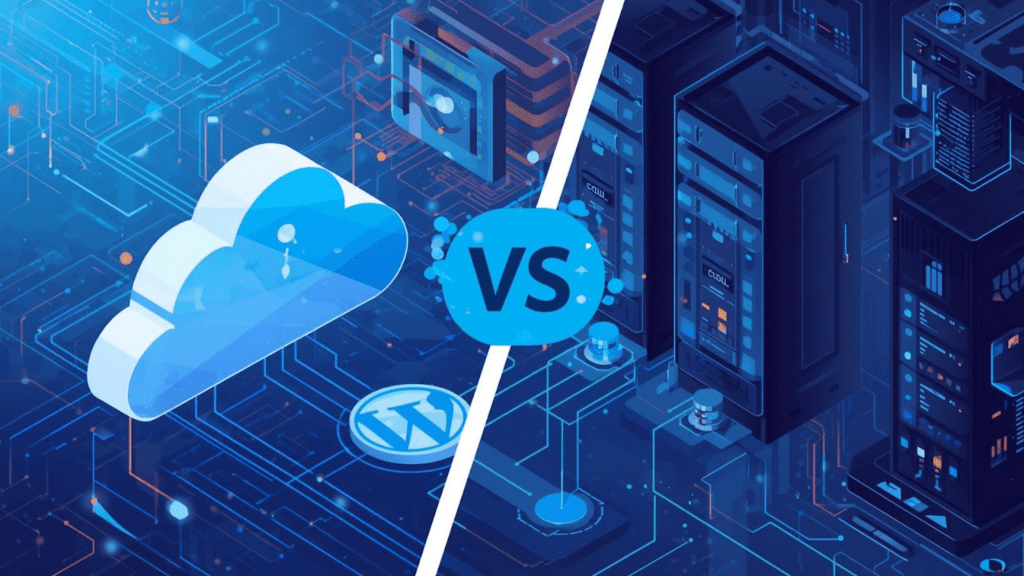
Choosing between cloud hosting and WordPress hosting ultimately comes down to a balance between control and convenience. Cloud hosting offers unmatched flexibility, scalability, and long-term ownership for teams with technical expertise or complex growth needs. WordPress hosting, on the other hand, excels in simplicity, speed of launch, and hands-off maintenance, making it ideal for content-driven teams and businesses that want reliable performance without managing their own infrastructure. The right choice is the one that aligns with your growth trajectory, technical capacity, and tolerance for operational complexity.
Frequently Asked Questions About Cloud Hosting vs WordPress Hosting: Key Differences Explained
What is the difference between cloud hosting and regular hosting?
Regular hosting, typically shared or single-server hosting, runs your site on one physical machine, often shared by hundreds of clients. Cloud hosting leverages multiple interconnected servers, delivering higher redundancy, scalability, and consistent uptime, making it more resilient against random surges or hardware failures that could bring your site down.
What are the 4 types of hosting?
The four main hosting types are:
- Shared Hosting – Sites are packed onto the same server, sharing all resources.
- VPS (Virtual Private Server) Hosting – A single server is split into multiple virtual machines, providing each user with isolated resources.
- Dedicated Hosting – One site, one server. Raw power—zero sharing.
- Cloud Hosting – Your workloads live on a dynamic network of servers, scaling up or down as needed.
Which type of hosting is best?
For mission-critical, performance-obsessed brands, cloud hosting or a well-architected VPS wins, hands down. Shared hosting often falls short in terms of reliability and speed. Dedicated servers are powerful but lack the redundancy of the cloud. The right answer depends on your traffic patterns, technical needs, and risk appetite; however, growth-oriented WordPress sites often outgrow shared hosting quickly.
What is the difference between SiteGround shared hosting and cloud hosting?
SiteGround shared hosting places your site on a crowded server, sharing bandwidth and CPUs with others, which can result in speed throttling during peak times. SiteGround cloud hosting offers isolated resources, improved uptime, and on-demand scaling, making it ideal for businesses that demand predictable performance, not just a low monthly bill.
How much RAM does a VPS need?
For a modern, production-grade WordPress stack, a minimum of 2–4GB of RAM is required. Scale up to 8GB or more for high-traffic sites, WooCommerce stores, or when running multiple complex plugins. Under-provisioned memory is the silent killer of site stability.
Is cloud hosting better than VPS?
Cloud hosting is essentially VPS taken to the next level: instant horizontal scaling, superior redundancy, and often built-in load balancing. VPS hosting provides isolated, predictable resources; however, scaling is manual, and downtime risk is higher. For long-term growth and true fault tolerance, cloud hosting is the gold standard.